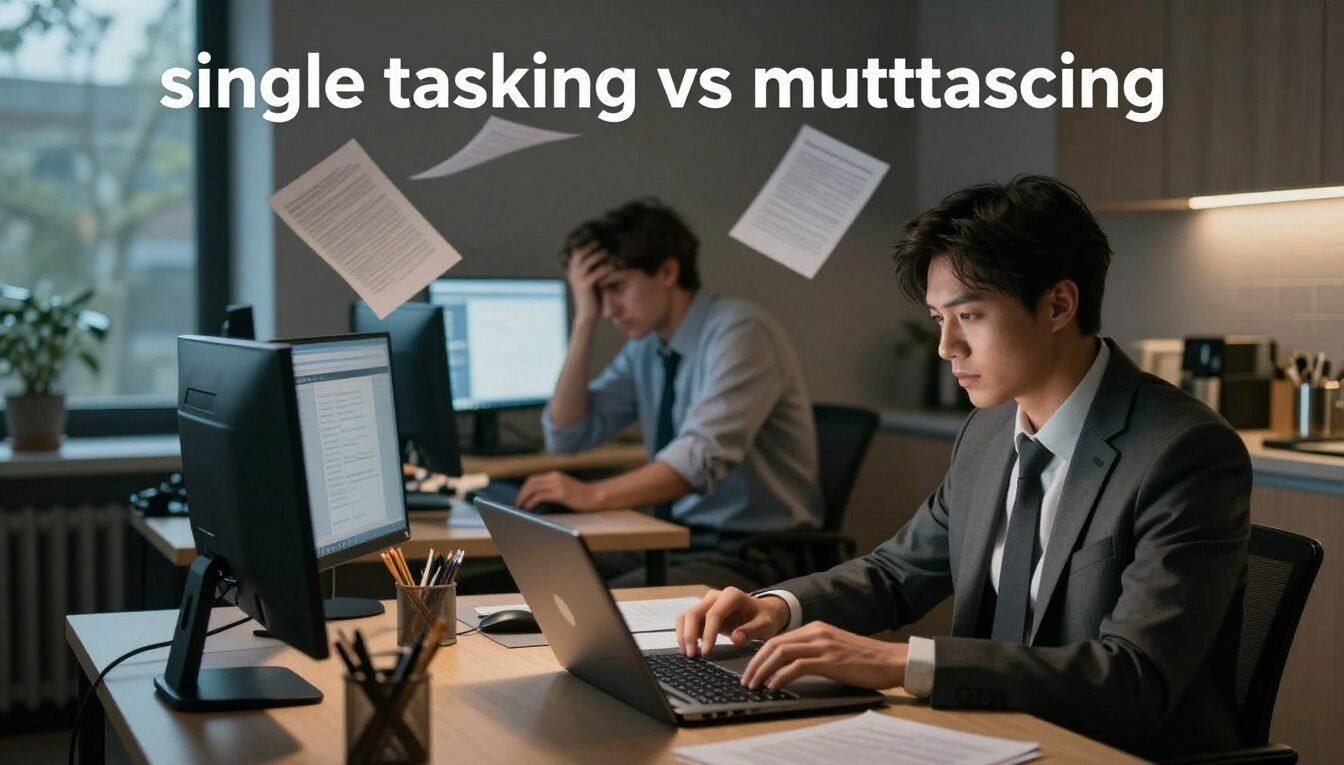
Why Multitasking Is Killing Your Productivity and What to Do Instead
You juggle many items every day and think this is the best way to get more done. Research shows your approach may actually cut your output and harm focus.
A University of London study found switching between activities can lower IQ by up to 15 points. That finding explains why your work feels harder and why your time slips away.
This introduction lays out a clear plan. You will learn how to prioritize tasks, protect your time, and boost productivity without constant switching. Practical tips will help you reshape your work and life so you meet goals with less stress.
The Reality of Multitasking in the Modern Workplace
In many jobs you must split attention across competing items, which eats into your time and focus. The constant switch between tasks reduces how deeply you can work and shortens the moments of real concentration.
The research is clear: a University of London study found that multitasking can lower IQ scores by up to 15 points. Your brain also uses roughly 20% of your daily energy on thinking. Together, those facts explain why productivity and performance fall when you try to do too much.
For example, checking email during a conference call seems small, but it drains attention and leaves you tired at day’s end. That habit affects your life outside work and makes projects take longer.
- Loss of efficiency: switching wastes time and slows overall work.
- More mistakes: handling multiple tasks increases errors and harms quality.
- Higher stress: juggling things drains energy and raises daily strain.
Understanding these realities helps you choose better ways to schedule tasks and protect your attention so you can improve results without burning out.
Understanding the Single Tasking vs Multitasking Debate
Trying to juggle multiple duties in the same block of time can quietly erode your output. This section explains how switching between duties and the myth of doing two things at once affect your productivity and day.
Defining Task Switching
Howard, Alipour, and Gutworth (2025) define task-switching as moving back and forth between duties. Each switch forces your mind to reassign resources and rebuild focus.
That re-calibration increases task time and raises the chance of errors. When you switch tasks often, your projects take longer and your goals slip out of order.
The Myth of Simultaneous Performance
MacPherson (2018) shows dual-tasking depends on how much cognitive resources each activity needs. In practice, your brain rarely supports true simultaneous work on two demanding duties.
For example, writing a report while checking email creates constant interruptions and distractions. Effective time management asks you to focus one task at a time and protect your mind for the most important work.
- Howard et al.: back and forth shifts cost focus and resources.
- Research: attempts to do two tasks raise tasks time and reduce quality.
- Practical way: order your goals and limit interruptions to improve focus.
The Cognitive Cost of Switching Tasks
Every time you change course between projects, your brain spends energy rebuilding focus and direction.
Research by Becker, Kaltenegger, Nowak, Weigl, and Rohleder (2023) shows that frequent interruptions and multitasking trigger biological stress responses. That stress lowers performance and makes the workday feel harder.
The human brain uses about 20% of your daily energy. When you switch tasks, that expensive organ must reassign resources, which increases task time and drains momentum.
The back forth movement between tasks reduces quality and efficiency. You also raise the likelihood of mistakes and hurt long-term productivity.
- Becker et al.: interruptions cause measurable stress and lower performance.
- Each switch forces your brain to re-map goals, costing time and energy.
- Good time management preserves attention and improves overall quality.
Focus on the task at hand to protect your limited cognitive resources and keep steady productivity through the day.
Benefits of Adopting a Single Tasking Approach
Shifting your attention less often preserves energy and makes each hour of work more valuable. Adopting a focused way of working changes how you use time and improves task outcomes.
Preserving Mental Energy
Your brain uses about 20% of daily energy. By reducing attention shifts, you conserve that energy for the work that matters most.
Improving Quality and Accuracy
Focusing on the task at hand reduces mistakes and raises quality. Liu and Yu (2024) note that dedicated attention leads to superior precision on professional projects.
Enhancing Creative Flow
When you remove distractions and interruptions, you can reach creative flow. This state helps solve hard problems and speeds progress on complex projects.
- Preserve energy by working on one task at a time.
- Improve quality work and cut mistakes on important tasks.
- Enter deeper flow when interruptions are limited.
- Train your mind to focus one task to boost efficiency and productivity.
These benefits help you meet goals with less strain and more consistent results. In the next section, you will learn practical techniques to master your focus.
Practical Techniques to Master Your Focus
Control how you spend your time by setting short, focused sessions for real work. Use the Pomodoro technique to split the day into 25–50 minute blocks. These sessions protect your energy and leave room for regular breaks to recharge your mind.
Pair time blocking with a clear order for tasks so each task gets its own slot. Plan which projects you will tackle and when, then treat each block as non-negotiable time for that task.
Use tools like Noisli to mask noise and improve concentration on your most important projects. Reduce open browser tabs to only those needed for the task at hand.
- Work in timed sessions to maintain high energy throughout the day.
- Block time to schedule tasks in a clear order and cut distractions.
- Use ambient tools to shield your brain from external noise.
- Limit tabs and notifications so you can focus one task at a time.
These techniques improve time management and help you avoid burnout. Apply them daily to raise productivity and protect attention for the work that matters.
When Multitasking Might Actually Be Useful
There are times when pairing two low-demand actions helps you use spare minutes without harming your main focus.

Scott (2023) notes that dual-tasking works for activities that do not need conscious effort, such as walking while listening to music.
Distinguishing Between Dual Tasking and Complex Work
For light routines, combining things can save time and lower boredom. Your brain can handle a passive activity alongside a simple one without large energy costs.
For complex projects, use task management tools like Trello, Asana, Todoist, or Notion. They keep multiple tasks and projects in order so your attention stays on the highest priorities.
- Use dual-tasking only for low-effort actions (example: walking and an audio lesson).
- Organize complex work with a management tool to protect your focus and energy.
- Prioritize tasks in order of importance to avoid stress and lost performance.
- Minimize distractions and take short breaks to sustain productivity through the day.
Conclusion
Small changes in how you use your time deliver strong benefits for focus, energy, and efficiency. Choose methods that fit your goals and guard the hours you need for deep work.
When you prioritize tasks and apply the tips and techniques above, you raise productivity and produce better quality work. Treat each block of time as a commitment and reduce distractions to protect your attention.
Multitasking can fit some light routines, but aiming for one task at a time usually improves results. Experiment with these ideas, track how your tasks flow, and adjust your management to suit your rhythm.
Use these closing tips to keep your time productive and your work less stressful.